
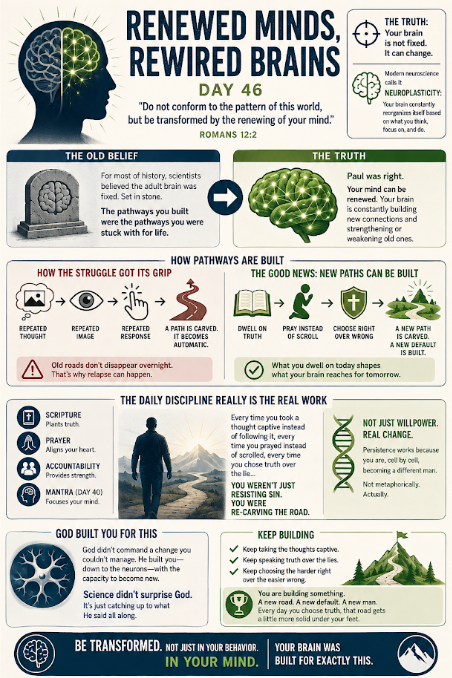
For most of history, if you'd asked a scientist whether the adult brain could actually change, the answer would have been no. Once you hit adulthood, the thinking went, your brain was basically fixed: set in stone. Whatever pathways you'd built by your twenties were the pathways you were stuck with for life.
Paul didn't get that memo. Two thousand years ago, writing to a church in Rome, he said this:
"Do not be conformed to this world, but be transformed by the renewal of your mind."
Not just your behavior. Not just your willpower. Your mind, actually renewed, actually changed.
Turns out, Paul was right, and the scientists were wrong.
Neuroplasticity
Modern neuroscience has a name for what he was describing: neuroplasticity, the discovery that your brain is not fixed at all. It's constantly reorganizing itself, building new connections and strengthening or weakening old ones, based on what you repeatedly think about, focus on, and do. Every time you rehearse a thought, good or bad, you're not just having a feeling. You're laying down wiring. The more you repeat it, the stronger and more automatic that wiring becomes.
Here's the part that matters for us: that's exactly how this struggle got its grip on you in the first place. It wasn't just a moral failure happening in a vacuum. It was also, quite literally, a pathway being carved. Repeated thought, repeated image, repeated response, again and again, until the path was worn smooth and your brain started reaching for it automatically, almost before you decided anything at all.
You don't have to rewire alone.
Prayer, Scripture, and a community walking the same six levels make a new pathway stick.
The good news hiding in the same science
If repetition built that pathway, repetition can build a different one. The brain doesn't just record damage. It's also, at every stage of adult life, capable of laying down brand new roads. What you dwell on today is quite literally shaping what your brain reaches for tomorrow.
That should change how you think about the daily discipline of this whole journey: the Scripture, the prayer, the accountability, the thought-capturing mantra from Day 43. None of that was spiritual decoration sitting on top of the real work. That was the real work. Every time you took a thought captive instead of following it, every time you prayed instead of scrolled, every time you chose truth over the lie, you weren't just resisting sin in the moment. You were re-carving the road. Building a new default. Making the next right choice a little more automatic than the last one.
This is why relapse in earlier days doesn't mean failure: old roads don't disappear overnight, and new ones take repetition to become sturdy. And it's why persistence actually works, not because you're gritting your teeth harder, but because you are, cell by cell, becoming a different man. Not metaphorically. Actually.
Science catching up to Scripture
There's something deeply moving in this. God didn't just command a change He knew you couldn't manage. He built you (down to the neurons) with the capacity to become new. The command in Romans 12 was never a burden dropped on top of a fixed, unchangeable brain. It was an invitation into a capacity He designed into you from the beginning.
Science didn't discover something that surprised God. Science is just now catching up to something He said all along.
So keep doing what you've been doing. Keep taking thoughts captive. Keep speaking truth over the lies. Keep choosing the harder right over the easier wrong. You're not just fighting a battle of willpower that resets to zero every morning. You are building something: a new road, a new default, a new man. And every day you choose truth, that road gets a little more solid under your feet.
Be transformed. Not just in your behavior. In your mind. Your brain was built for exactly this.
This is Day 46 of Victory Over Pornography. Continue to Day 47 →