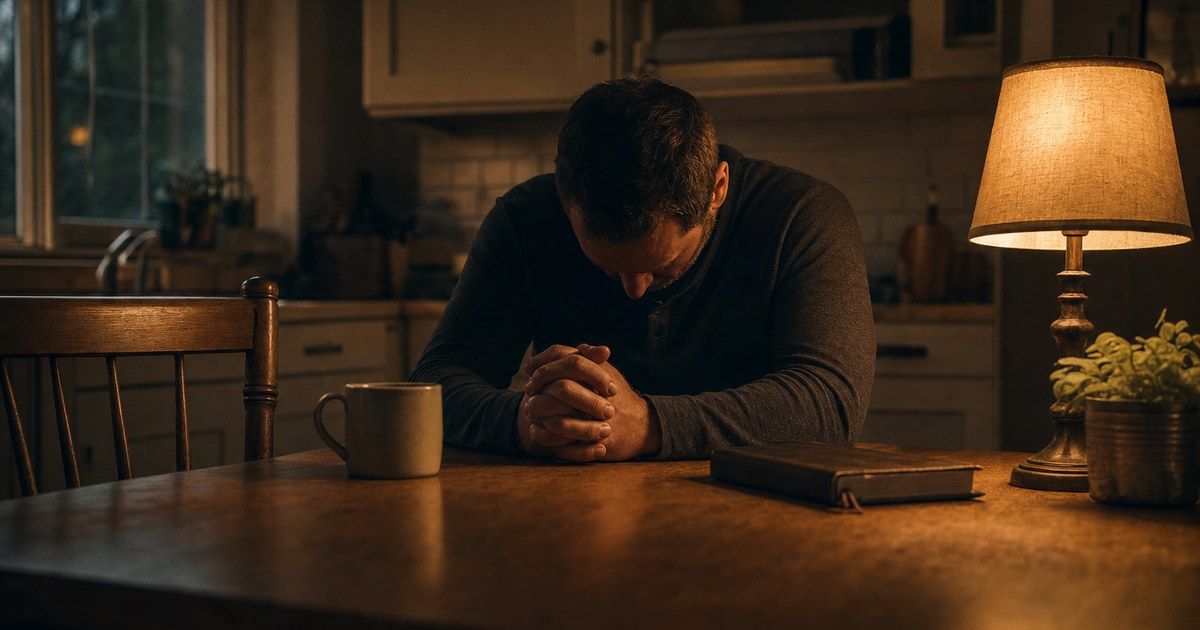
Today I'd like to answer a question that many wives have after discovering pornography, even if they don't always ask it this way: what is my husband feeling right now?
I can't speak for every husband. Every man is different, every marriage is different. But I can tell you what I felt, and after years of pastoring and talking with men who have struggled with pornography, I can tell you what I've heard over and over again. There are three main things your husband is likely feeling, then I'm going to tell you the one thing that fixes all three.
1. Shame, and Why It's Different From Embarrassment
The dominant emotion is shame. I don't mean embarrassment. Those aren't the same thing. Embarrassment says, "I did something foolish." Shame says, "There is something fundamentally wrong with me," followed by, "If anyone knew, they would reject me." It's self-disgust, even more than sin-disgust.
That's one of the reasons pornography becomes such a lonely sin. Men don't usually wake up one morning and decide they want to become liars. They become hiders. They begin believing that if anyone really knew what was going on inside them, they would be rejected. So they promise themselves they'll deal with it quietly, beat it on their own, never do it again. But they don't, and every failure reinforces the shame.
This is not a new pattern. It's the oldest pattern in human history.
And they heard the sound of the LORD God walking in the garden in the cool of the day, and the man and his wife hid themselves from the presence of the LORD God among the trees of the garden. But the LORD God called to the man and said to him, "Where are you?" And he said, "I heard the sound of you in the garden, and I was afraid, because I was naked, and I hid myself."
Genesis 3:8-10 (ESV)
That's the whole pattern, three thousand years before your husband was born. Sin, then shame, then hiding, then a God who comes looking anyway and asks a question he already knows the answer to. Adam didn't run because God was cruel. He ran because shame convinced him hiding was safer than being found. Your husband's instinct to hide from you follows the exact same script.
Unconfessed sin doesn't just sit quietly, either. It has a cost, and David wrote about that cost from personal experience:
For when I kept silent, my bones wasted away through my groaning all day long. For day and night your hand was heavy upon me; my strength was dried up as by the heat of summer... I acknowledged my sin to you, and I did not cover my iniquity... and you forgave the iniquity of my sin.
Psalm 32:3-5 (ESV)
That's a physical description of what hidden sin does to a person, exhaustion, heaviness, something like being dried out from the inside. If your husband seems tired, irritable, or strangely heavy even before you found out, this may be part of why.
Two Very Different Voices
Shame also creates another problem. It begins to distort the way a man hears God. The Holy Spirit brings conviction: "You've sinned. Bring it into the light. Repent. Come home." Shame, or what the Bible would call condemnation, whispers something entirely different: "You're disgusting. You're hopeless. You'll never change. Don't tell anyone. Just hide."
For godly grief produces a repentance that leads to salvation without regret, whereas worldly grief produces death.
2 Corinthians 7:10 (ESV)
Worldly grief says "I got caught" or "I hate myself" without ever actually moving toward God. Godly grief is different: it doesn't just feel bad, it actually turns and walks somewhere. What finally begins changing a man is not deeper shame. It's bringing his sin into the light and discovering that God's grace is actually greater than the thing he's been hiding.
Whoever conceals his transgressions will not prosper, but he who confesses and forsakes them will obtain mercy.
Proverbs 28:13 (ESV)
That's why honesty is such an important part of recovery. A husband who finally tells the truth is doing a lot more than sharing information with you. He's breaking one of shame's greatest weapons: secrecy.
2. Fear
Your husband may also be deeply afraid right now. Afraid you'll leave. Afraid you'll never respect him again. Afraid his children will find out. Afraid he'll fail again. Fear doesn't excuse sin, but it does explain why confession is often so difficult.
One of the greatest gifts a wife can give her husband is making it clear that, however painful the truth might be, she would rather hear it than discover another lie. That doesn't remove consequences or instantly restore trust, but it creates a marriage where telling the truth is always safer than continuing the deception.
There is no fear in love, but perfect love casts out fear. For fear has to do with punishment, and whoever fears has not been perfected in love.
1 John 4:18 (ESV)
That verse is describing God's love for us first and foremost. But it also describes something true about what a safe marriage can offer in miniature: a place where fear of punishment doesn't have to be the only thing driving honesty.
A full companion guide built for exactly where you are.
Understanding his battle, protecting your heart, and knowing what comes next.
What Actually Produces Change
Many wives, without ever saying it out loud, begin to believe that if they can make sure their husband feels the full weight of what he's done, that pain will finally motivate him to change. I understand that completely.
But here's what I'd ask you to consider. If your husband is genuinely repentant, shame is probably not in short supply already. He likely doesn't wake up thinking, "This isn't a big deal." He wakes up thinking, "I can't believe I've done this again. What's wrong with me?" If that's true, adding more shame rarely produces more holiness. More often, it produces more hiding. That's one of Satan's oldest strategies: convince us that because we've sinned, we should run away from the very people who could help us.
Do you presume on the riches of his kindness and forbearance and patience, not knowing that God's kindness is meant to lead you to repentance?
Romans 2:4 (ESV)
Not his wrath. Not his disgust. His kindness. If that's how God moves a person toward repentance, it's worth asking whether shame was ever the right tool for you to reach for either. Your job isn't to make your husband feel guilty enough to change, the Holy Spirit is very capable of bringing conviction. Your role is to insist on truth, to maintain wise boundaries, and, where repentance is genuine, to help create a home where honesty is always safer than deception.
Please don't misunderstand me. That doesn't mean there shouldn't be consequences, or that trust should come easily, or that you minimize what he's done. It simply means you don't use shame as a tool for transformation. God has given us a better tool than that: truth, repentance, and grace.
A Few Steps to Take This Week
- Learn the difference between godly and worldly grief (2 Cor 7:10) well enough to explain it in your own words. Worldly sorrow says "I got caught." Godly sorrow says "I have wounded people, and I need God, and I need help."
- When he confesses something, resist two opposite pulls at once: rescuing him from the discomfort of his own conviction, and piling additional shame on top of what he already carries.
- Prepare one steady first response for the next hard confession, decided now rather than in the moment: "Thank you for telling me the truth. I need some time before I can respond fully."
- If you notice yourself trying to increase his shame as a strategy, even subtly, pause and ask whether it's actually working.
- Notice whether your home is becoming a safer place for truth or a more dangerous one. That single question is one of the most important diagnostic questions you can ask about your marriage right now.
Shame told your husband, for a long time, that hiding was safer than being known. Your calling isn't to remove all consequences or manufacture more guilt, it's to help build a home where the truth has somewhere safe to land. In the next article: how long is this going to take, and what should you actually expect?