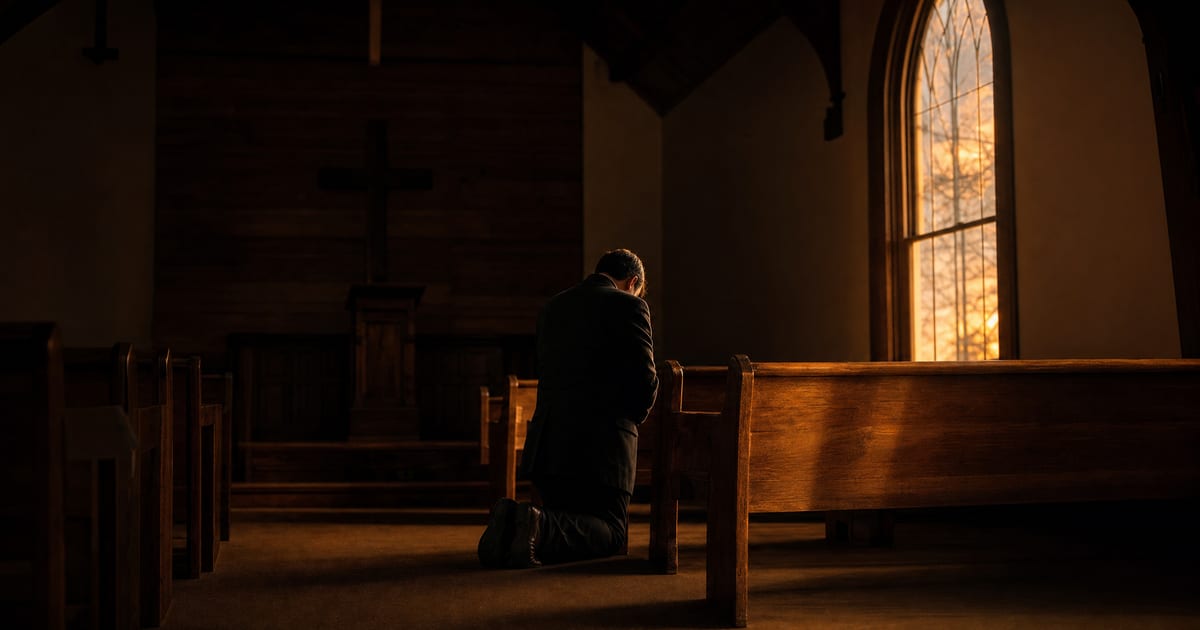
Most elder boards never think about this question until the moment they desperately need an answer to it.
That's not a criticism, it's just how these things tend to go. A pastor sits down across from his elders, or a denominational leader, and says words that no one in the room was prepared to hear. And in that moment, with no policy on the shelf and no process already agreed upon, a group of well-meaning men are suddenly making enormous decisions, about a family's future, a church's health, and a man's calling, entirely by instinct, under pressure, in real time.
I've written elsewhere about how common this actually is: 86 percent of pastors believe pornography use is common among their peers, yet only 9 percent of churches have any program in place to address it. That gap is exactly where elder boards get caught flat-footed. If you're reading this because you're facing this situation right now, or because you want to be ready before you ever have to, this article is for you.
I want to walk you through how to respond, biblically, wisely, and in a way that actually leads toward healing rather than just damage control.
Start With the Right Goal
Before any process, any policy, any decision about the pastor's role, get the goal right, because everything downstream follows from it.
The goal of this process is not protecting the institution's reputation. It's not managing the story. It's not simply determining punishment. The goal, first and foremost, is the healing of the pastor, his marriage, and his family, with the health of the church held as a real and serious concern alongside that, not ahead of it.
Paul's instruction in Galatians 6:1 sets the tone for the entire process: “Brothers, if anyone is caught in any transgression, you who are spiritual should restore him in a spirit of gentleness. Keep watch on yourself, lest you too be tempted” (ESV). The word is restore, the same word used for setting a dislocated joint back into place. Not discard. Not merely discipline. Restore.
And after Paul instructs the Corinthian church to address serious sin directly, he pivots almost immediately to guard against the opposite danger, a correction so severe it crushes the person instead of restoring him: “For such a one, this punishment by the majority is enough, so you should rather turn to forgive and comfort him, or he may be overwhelmed by excessive sorrow. So I beg you to reaffirm your love for him” (2 Corinthians 2:6–8, ESV). An elder board that only knows how to punish, and doesn't also know how to comfort and reaffirm love once genuine repentance is present, has only done half of what Scripture actually asks of it.
Keep It Confidential, By Default
The single most important structural decision an elder board makes in the first hours after a confession is who gets told, and how many people.
Jesus gives the pattern in Matthew 18: address sin privately first, and only widen the circle if genuine repentance isn't present (Matthew 18:15–17). The default posture toward a pastor's confession should be the same, keep it to the smallest circle that can responsibly handle it. That typically means the elder board, or a small restoration team the board appoints, rather than the whole congregation, the denomination at large, or (worst of all) the informal grapevine that starts the moment three people know instead of one.
This isn't about hiding sin. It's about stewarding a genuinely fragile situation wisely, protecting the pastor's family from a level of public exposure that serves no redemptive purpose, and creating a setting where honesty is actually safe enough to happen in the first place. Confidentiality and accountability are not opposites, done well, they work together. The restoration plan itself should stay confidential to as small a group as wisdom requires. The fact that your church has a policy for handling this can be, and should be, completely public.
There is a biblical limit to this confidentiality, and elder boards need to know it going in: 1 Timothy 5:19–20 instructs that elders who persist in sin, after being properly confronted, are to be corrected publicly, specifically so others are warned. That provision exists for a very different situation than a pastor who has confessed and is entering a genuine restoration process, it's aimed at ongoing, unrepentant sin, not a man who came forward and is doing the work. But your board should understand that line exists, and what would move a case across it: persistent deception, refusal to submit to the process, or continued behavior after commitments have been made.
Point him toward a real path forward.
Part of what a restoration plan requires is enrollment in a structured recovery program. This is the one we built.
Build a Small Restoration Team, Not a Committee of the Whole
Don't let this get handled by your entire elder board plus whoever happens to be in the room, making decisions on the fly. Appoint two or three people, elders or trusted denominational leaders, specifically tasked with walking this process, meeting regularly with the pastor, and reporting to the wider board only what the wider board actually needs to know to fulfill its own responsibilities.
If possible, this team should include or consult someone who already has a relationship of trust with the pastor, ideally another pastor who can accompany him through the hardest early conversations, rather than him facing an elder board entirely alone from the first meeting. The goal is a process that feels like walking alongside a brother, not standing before a tribunal.
What to Require of the Pastor
Here is where a real restoration plan gets concrete. A confession alone is a beginning, not a plan. What follows should include real, specific requirements, not as punishment, but as the actual scaffolding real change is built on.
- Filtering and accountability software. This should be non-negotiable and installed quickly, on every device, with reporting visibility to someone on the restoration team or a trusted accountability partner. It's not a cure by itself, but it closes an obvious door while deeper work happens.
- Enrollment in a structured recovery program. A confession followed by vague good intentions rarely holds. A structured course, something like the program I've built, which walks a man through six specific levels addressing not just behavior but the roots underneath it, gives the process actual content and a defined path, rather than leaving “get better” undefined.
- A real accountability community, both online and local, not just a single accountability partner he checks in with occasionally, but an ongoing structure of people who know the truth and are actively walking with him. I've written about this in more detail elsewhere in this series; the short version is that isolation is often part of what got a pastor here, and isolation cannot be part of the solution.
- Counseling, ideally with someone trained specifically in sexual integrity or addiction-pattern work, not just general pastoral counseling. Depending on the severity and duration of the struggle, this may need to run six months to well over a year.
- Support offered to his spouse. Her healing is not automatic just because his restoration plan exists, and it is not her job to manage his recovery. Offer her counseling support directly, separate from anything designed around him, she is not a supporting character in this process; she has her own wound to attend to, which I've written about separately.
- Ongoing reporting and defined check-in points. Build in specific re-evaluation meetings, at three months, six months, a year, rather than an open-ended “we'll know it when we see it” arrangement. Everyone, including the pastor, does better with clear checkpoints than with ambiguity.
The severity and duration of each of these should scale with the nature of the struggle itself. A pastor who proactively confessed an occasional, early-stage struggle needs a lighter, shorter process than one whose pattern was compulsive, hidden for years, and only surfaced through discovery rather than confession. Building a policy with defined levels, rather than one-size-fits-all, lets your board respond proportionally instead of either overreacting to a minor struggle or underreacting to a serious one.
Elder Accountability Goes Both Directions
It's worth naming directly: the restoration team itself needs accountability too. Set a defined membership, rotate or review it periodically, and make sure the team is reporting honestly to the full board rather than becoming its own unaccountable inner circle. A process built to protect the pastor from being crushed by exposure shouldn't accidentally become a process that shields him from real accountability either. Both dangers are real, and a good policy names both.
You Don't Have to Build This From Scratch
I helped write a restoration policy for pastors and licensed ministers in our own denomination, built around exactly the framework above, confidentiality by default, a defined restoration team, level-based requirements scaled to the severity of the struggle, and a stated goal of healing rather than punishment. It's currently in real use, not a theoretical document. I've also written a full breakdown of how the policy's three levels of use work, if you want to see the framework in more detail before deciding whether to adopt it.
I'm making the full policy available as a free download so your board doesn't have to draft something like this alone, under pressure, in the middle of an actual crisis. Adapt the names, roles, timelines, and denominational specifics to fit your own church's governance, but the framework itself, and the underlying philosophy behind it, took real work to get right, and you're welcome to start from it rather than starting from a blank page.
Download: Restoration Policy Template (PDF)
Enter your email and we'll send you straight to the download. We'll also follow up with a short breakdown of how to adapt the policy to your own church's governance.
Your download is ready: Restoration Policy Template (PDF)
Read it now, before you need it. The boards that handle this well are almost never improvising in the moment, they're executing a plan they had the wisdom to build before the crisis arrived.