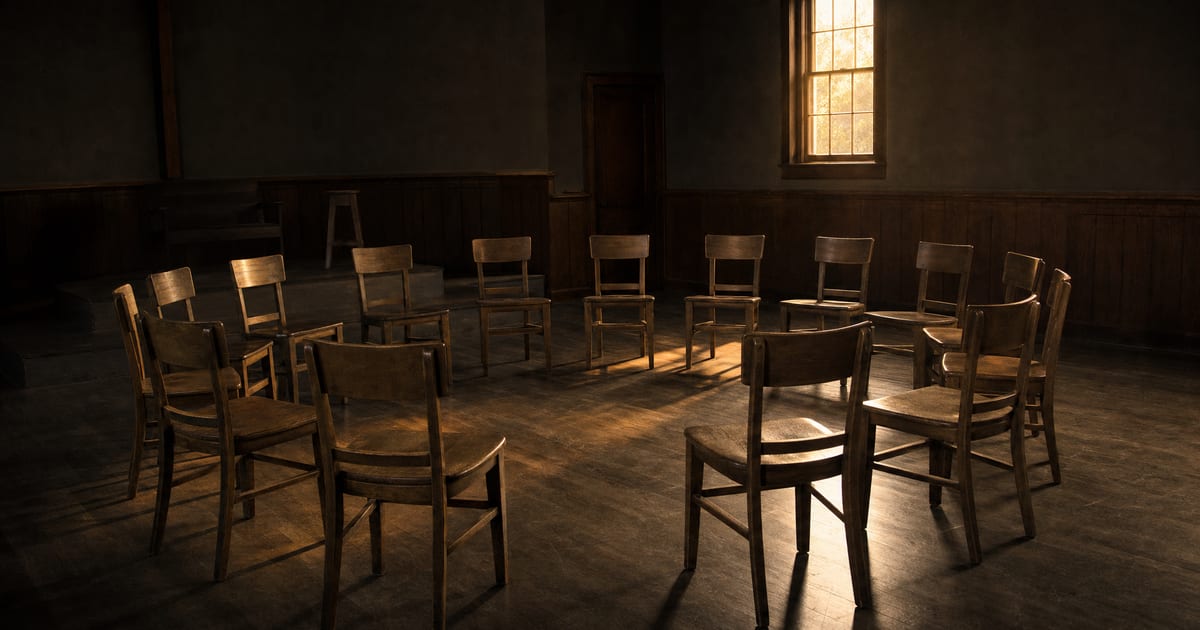
I sat in the front pew of my own church building on a Saturday night, alone, praying.
I knew exactly what I was supposed to preach the next morning. Grace. Salvation. The power of God to break the chains of sin in a person's life. I could have preached it in my sleep, I believed every word of it, had believed it since before I could remember not believing it.
And I also knew what I'd looked at that same day. I sat there in the quiet of that sanctuary, in the same room I'd stand in twelve hours later with my hands raised and my Bible open, carrying a shame I didn't know what to do with.
The enemy sat down next to me in that pew, that's the only way I know how to describe it, and he didn't have to raise his voice. He just whispered:
“You're a fraud. God won't help you.”
I want to tell you that I immediately quoted Scripture back at him and the moment passed in triumph. That's not what happened. What happened is I sat there believing him, at least a little, for longer than I want to admit. Because that's what shame does. It doesn't argue with you. It just sits next to you and states things as fact until you stop questioning them.
I'm telling you this because I have come to learn something in the years since that night that would have changed everything if I'd known it at the time: I was not remotely alone in that pew. Not figuratively, literally. Statistically, at that very moment, tens of thousands of other pastors across the country were sitting in their own version of that same seat, believing their own version of that same lie.
It's brutal. But I'm not alone. And if you're a pastor reading this, neither are you.
Let me show you the numbers.
You Are Not Alone: Here's the Data
The most rigorous research available on this topic comes from Barna Group, working in partnership with Pure Desire Ministries. Barna first studied pornography and the American church in 2015 with a landmark report called The Porn Phenomenon, commissioned alongside Josh McDowell Ministry. In 2024, they returned to the subject with a follow-up study, Beyond the Porn Phenomenon: Equipping the Church for a New Conversation About Pornography, Betrayal Trauma and Healing, this time surveying 462 senior Protestant pastors, nearly 3,000 U.S. adults with an oversample of practicing Christians, and 205 Christian youth leaders.
Here is what nine years of data, collected the same rigorous way both times, actually shows:
- Two out of three pastors, 67 percent, say they have struggled with pornography at some point in their lives. That's up from 57 percent when Barna first asked the question in 2016. The number is not shrinking. It's growing.
- Nearly one in five pastors, 18 percent, say pornography is a current struggle, not a past one. Right now. This week.
- 86 percent of pastors believe pornography use is common among Christian pastors. Think about what that means: this is not a secret most pastors think they're the only one keeping. Most of them already suspect the man in the pulpit next door is carrying the same thing they are. They just don't have any idea how to say so.
- Only 9 percent of pastors say their church has an actual ministry program to help people struggling with pornography, up only slightly from 7 percent when Barna asked in 2015. Nine years, and the needle barely moved.
I want to sit with that last number for a second, because I think it's the most important one on this list. Eighteen percent of pastors are struggling right now. Only nine percent of churches have anything in place to help anyone with that struggle, pastor or layperson. We have a problem that's growing, and a response that's standing nearly still.
Why So Many Pastors Stay Silent
Barna's original 2016 study found something that I think explains almost everything else on this list: among pastors currently struggling with pornography, 55 percent said they live in constant fear of being discovered.
Not constant conviction. Not constant repentance. Constant fear of being found out.
That distinction matters more than it might seem to at first. Fear of discovery and godly conviction over sin produce completely different behavior. Conviction drives a man toward confession, toward James's instruction to “confess your sins to one another and pray for one another, that you may be healed” (James 5:16, ESV). Fear of discovery drives a man toward better hiding: incognito browsing, cleared histories, increasingly careful management of a double life. It doesn't make the struggle smaller. It just makes it quieter, and more isolating, and more dangerous over time.
And pastors have very specific reasons to be more afraid of discovery than almost anyone else in the congregation. A layperson who confesses a porn struggle to their small group risks embarrassment. A pastor who's discovered risks his income, his housing in some cases, his family's health insurance, his reputation in an entire community, and often his sense of calling itself. The stakes of confession are simply higher for the person standing behind the pulpit, which means the pull toward silence is stronger, not weaker, for exactly the people whose spiritual health the whole congregation is depending on.
This is also, frankly, a structural problem, not just a personal one. Who does a pastor actually talk to? His elders, who he reports to and who evaluate his job performance? His congregation, who looks to him for spiritual leadership and stability? Most pastors have remarkably few peers they can be fully honest with. I've written more directly about who a struggling pastor should actually tell, but the short version is: the isolation of the role itself is part of what keeps this hidden.
You don't have to carry this alone.
The same six-level program built for any man in this struggle was shaped by a pastor who lived it. Start where you are.
The Impact on Pastoral Marriages and Families
Barna's 2024 research made a point of naming something that earlier studies mostly left out: for every person struggling with pornography, there is very often a spouse quietly carrying the weight of what researchers call betrayal trauma, the deep, disorienting wound that comes when the person you depend on most for security and trust has broken that trust.
And once again, the data shows churches are not equipped to help. Most Christians and churched adults say their church either has no program to support betrayed spouses (45 percent) or they simply don't know if one exists (39 percent). That means pastors' wives, women who are already carrying the unique weight of ministry life, who are watching their husbands from a front-row seat no one else has, are, in most cases, facing this completely alone, with no structured place in their own church to bring it.
I don't have a tidy statistic for what that does to a marriage over years of silence. I don't think one exists that captures it honestly. What I do know, from having lived close enough to this struggle to know its texture, is that secrecy is corrosive in a marriage in a way that almost nothing else is. Not because the sin itself is unforgivable, it isn't, but because secrecy requires ongoing deception to maintain, and ongoing deception slowly poisons the trust a marriage is actually built on, even when the spouse doesn't yet know why something feels wrong. I've written more on exactly what makes ministry marriages uniquely vulnerable to this, and what real healing looks like.
The Impact on the Church Itself
Here's the part of this article I can't source from Barna, because I don't think it's the kind of thing a survey instrument can fully measure. But I can tell you what I watched happen from the inside.
While I was struggling with pornography, my church stagnated.
I don't say that to be dramatic. I say it because it's true, and because I think it's a piece of this conversation that gets skipped over in favor of statistics that are easier to count. Spiritual authority doesn't evaporate the moment a pastor sins, thank God, because none of us would have any authority left if that were true. But there is a real cost to leading from a place of hidden compromise instead of walked-out freedom, and I felt that cost in ways I couldn't always name at the time. Prayer that felt like performance instead of power. Preaching on freedom I wasn't currently walking in. A reluctance to press into certain topics too hard, because I knew where my own compass was pointing when I did. A general flatness in my own spiritual leadership that I couldn't explain to anyone, including myself, because admitting the real cause meant admitting the thing I was most afraid to say out loud.
I can't prove a causal line with a chart. But I lived close enough to it to know it wasn't a coincidence.
What Barna's data can show is what happens on the other side of that equation, when a church actually builds structure around this issue instead of ignoring it. Among people struggling with pornography who attend a church with an actual program addressing it, 52 percent say they have someone helping them avoid it. Among those at churches without a program, that number drops to 14 percent, nearly a fourfold difference. Structure and honesty don't just help the individual pastor or church member. They appear to change the entire trajectory of whether anyone gets free at all. I've written a full guide for elder boards on how to build that kind of structure, including a free restoration policy template.
I believe the same principle holds true at the level of a single life and a single pulpit. A church led by a pastor who is walking in secrecy will feel that secrecy, even when no one can name why. A church led by a pastor walking in the light, even a pastor who has failed and is honestly, actively pursuing freedom, carries something different. Not because the second pastor is sinless. Because he's not hiding.
The Lie in the Pew, and the Truth That Answers It
I want to go back to where I started, because I think it matters that this article ends where it began.
“You're a fraud. God won't help you.”
That's what the enemy whispered to me in that empty sanctuary, and I believed enough of it to stay silent longer than I should have. But here's what I know now that I didn't know then: that sentence has two lies stacked inside it, and both of them fall apart under the weight of what's actually true.
You're a fraud. No, you're a sinner who is also called, which describes literally every pastor in Scripture and every pastor since. Paul called himself the chief of sinners in the same breath he called himself an apostle (1 Timothy 1:15–16). David wrote some of Scripture's deepest worship out of the wreckage of his worst failure. Peter denied Christ three times in public and was still handed the keys to shepherd the early church. The calling was never contingent on having no struggle. It was always contingent on what you do with the struggle once it's named.
God won't help you. This is the more dangerous lie, because it's the one that keeps a man silent. It isn't true, and it has never been true, for anyone who has actually brought their sin into the light instead of managing it in the dark. “If we confess our sins, he is faithful and just to forgive us our sins and to cleanse us from all unrighteousness” (1 John 1:9, ESV) isn't a verse for laypeople only. It has your name on it too, whatever your title is on Sunday morning.
If you're a pastor reading this in your own version of that pew, carrying your own version of that shame, I want you to hear the two things I most needed to hear back then. The numbers you just read prove the first one: you are not alone, not statistically, not really. And the gospel you preach every week proves the second: the God who called you into this in the first place has not changed His mind about you because of what you looked at on a Saturday.
What you do next is the whole question. I've written a direct, step-by-step answer to it here, and I'd encourage you to read it next.