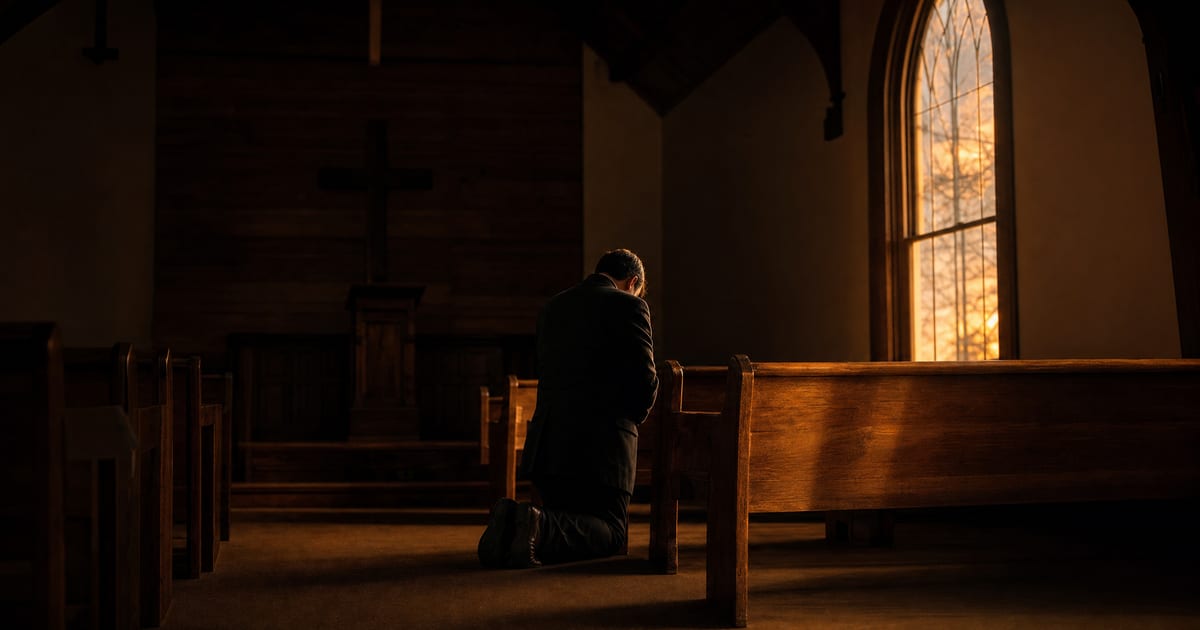
I remember the specific weight of it, not the sin itself, but the silence around it. Years into ministry, I was carrying a struggle I didn't know what to do with, and the two things standing between me and getting help weren't logistics. They were fear and shame.
Fear of what people would think of a pastor who said those words out loud. Shame that made me believe the struggle itself proved something disqualifying about my character, my calling, maybe even my salvation. I knew, the way you know something in your body before you can say it in words, that if I opened my mouth, I might lose more than my secret. I might lose my pulpit, my income, my reputation, the trust of people I loved.
So I didn't say anything. Not for a long time.
I'm telling you that because I know exactly what's going on in the mind of the pastor reading this article right now, or the elder who just found out about one of his own. And I know what's going on in the mind of the pastor who's never struggled a day in his life but is trying to figure out what justice and mercy actually require when a fellow shepherd falls.
Two questions sit underneath almost everything else people ask me about this topic:
Should a pastor resign if he's looked at pornography?
Does pornography use disqualify a man from ministry altogether?
I want to give you a real answer to both, not a hedge, and not a rule. My answer, and I'll defend it from Scripture, from data, and from a restoration policy I helped write for actual use in an actual denomination, is this:
Not necessarily. It depends.
That's not a cop-out. It's the beginning of a framework that will actually hold up when you need it, whether you're the pastor in the struggle, the elder board deciding what to do, or the church member trying to understand why your pastor is still in the pulpit after a season of restoration.
The Question Behind the Question
Before we get to “should he resign,” we have to answer something more basic: how common is this, actually?
Because the honest answer changes everything about how we respond.
Barna Group, partnering with Pure Desire Ministries, has tracked pastors and pornography since 2015. Their most recent research is not a fringe finding from a handful of troubled men. Two out of three pastors, 67 percent, say they've struggled with pornography at some point in their lives. Nearly one in five, 18 percent, say it's a current struggle right now, today, this week. That number has been climbing since Barna's first study in 2015, not falling. And 86 percent of pastors believe pornography use is common among their fellow clergy, which tells you this isn't a secret pastors are keeping from each other so much as a shared, unspoken reality nobody wants to be the first to name out loud.
Go back to Barna's original 2016 study, “The Porn Phenomenon,” commissioned with Josh McDowell Ministry, and one number stands out even more than the usage statistics: 55 percent of pastors currently struggling with pornography say they live in constant fear of being discovered.
Sit with that for a second. Not fear of God. Not conviction over sin. Fear of discovery. That's the posture shame produces, not repentance, but hiding. And it's the posture our response, as churches and denominations, either reinforces or begins to heal.
Do the Math With Me
Here's where I want to push past the abstract statistics into something concrete, because I think most people, even most elder boards, have never actually run these numbers.
Barna's research puts the number of senior Protestant pastors serving in the United States at roughly 300,000. The Hartford Institute for Religion Research counts around 335,000 Protestant congregations nationwide. Those numbers are close enough to make the point cleanly: there is very nearly one pastor for every church in America.
Now apply the statistics.
If 18 percent of pastors are currently struggling with pornography, that's somewhere around 54,000 pastors, right now, today, carrying this privately.
If we go further and count everyone who has ever struggled, the 67 percent figure, we're talking about roughly 200,000 pastors, or two out of every three men standing in an American pulpit this Sunday.
Now ask the question underneath the question I opened with: if the standard is automatic resignation for any pastor who has ever looked at pornography, what does the American church look like on the other side of that policy?
It looks like somewhere in the neighborhood of 200,000 pulpits emptied. Not 200,000 pastors quietly transitioning to new careers, 200,000 men suddenly without income, without vocation, without the calling they've given their lives to, in addition to whatever consequences their sin has already produced in their marriage and their walk with God. And on the other side of that ledger: as many as a third of American Protestant churches, potentially, searching for a new pastor at the same time, in a system that already struggles to train and place pastors fast enough to meet demand.
I'm not offering that number to minimize the sin. Pornography use is sin, full stop, no asterisk, no cultural excuse. I'm offering that number because I think most people arguing for automatic resignation have never actually pictured what automatic resignation would produce at scale. It would not produce a purer church. It would produce a church leadership crisis married to a mental health crisis married to a family crisis, multiplied by six figures.
The Fear-Shame-Career Triangle
Here's the question I really want to press on, because I think it's the one that should end most “automatic resignation” arguments before they start:
If fear and shame already keep most struggling pastors silent, 55 percent living in constant fear of being found out, according to Barna's own numbers, what happens when we add “instant, guaranteed loss of your career and income” to that fear?
Does that make a struggling pastor more likely to come forward? Or less?
I think you already know the answer. I lived the answer. When the cost of confession is total, not just spiritual accountability, not just a hard conversation with your wife and your elders, but the complete loss of your calling and your paycheck, the rational move, in the moment temptation or conviction hits, is to stay quiet a little longer. Try to fix it yourself. Hope no one finds out. That's not a defense of the silence. It's a description of exactly how the incentive structure works, and it's the same incentive structure that keeps addictions of every kind hidden until they've done maximum damage.
A policy that guarantees career death for any confession doesn't produce fewer struggling pastors. It produces fewer confessing pastors, and more pastors who get caught years later, after the deception has compounded, after trust has been broken in ways that go well beyond the original sin, after there's a spouse who feels blindsided instead of walked alongside, after there's a church that feels betrayed instead of informed.
If our policies make confession more dangerous than concealment, we shouldn't be surprised when men choose concealment. We should ask what we built.
Confession is the doorway, not the end.
Whatever your leadership requires next, the program that walks a man from confession to real, sustained victory is built on exactly this framework.
So Does Pornography Disqualify a Pastor From Ministry?
Let's deal with the text most people reach for on this question: 1 Timothy 3:1–7. Paul's qualifications for an overseer include that he “must be above reproach… sober-minded, self-controlled, respectable… well thought of by outsiders, so that he may not fall into disgrace, into a snare of the devil” (1 Timothy 3:2, 7, ESV).
Notice the tense. “Must be above reproach” is present tense, an ongoing state, not a permanent, unbroken historical record. Paul isn't asking whether a man has ever sinned. If that were the standard, no man would ever qualify, because “all have sinned and fall short of the glory of God” (Romans 3:23, ESV). Paul is describing the current, observable trajectory of a man's character: his self-control now, his reputation now, the pattern of his life now. It's a description of a man walking in the light, not a record with zero blemishes on it.
Scripture actually gives us direct precedent for restoring leaders after serious moral failure, not just for holding a permanently spotless standard.
Peter denied Christ three times, in public, at the exact moment his Lord needed him most, arguably a more severe and cowardly failure than a private struggle with pornography. And after the resurrection, Jesus doesn't disqualify him. He restores him, three times, matching the three denials: “Simon, son of John, do you love me?… Feed my sheep” (John 21:15–17, ESV). Peter goes on to preach the sermon at Pentecost and lead the early church. His failure was public and severe. His restoration was total.
David committed adultery and orchestrated a murder to cover it up, sins of a different magnitude and category than viewing pornography, and I want to be careful not to flatten that distinction. David held a different office than a pastor, under a different covenant, and his sin included direct harm to real victims that a private struggle with pornography does not. But the restoration principle still matters: David wasn't discarded. He faced severe, real consequences, Nathan's confrontation, the death of his son, a fractured household for the rest of his life (2 Samuel 12), and he also wrote Psalm 51 from the other side of confession, becoming one of Scripture's clearest pictures of a broken and contrite heart that God does not despise.
Galatians 6:1 gives us the operating instructions for situations like this: “Brothers, if anyone is caught in any transgression, you who are spiritual should restore him in a spirit of gentleness. Keep watch on yourself, lest you too be tempted” (ESV). The verb is restore, not discard, not merely discipline, not simply remove. Restore.
So: does pornography disqualify a pastor from ministry? Not automatically, and not permanently. It exposes a real struggle that must be taken seriously, addressed honestly, and walked through with real accountability, but Scripture's own qualification language and Scripture's own restoration narratives both point toward a present-tense, trajectory-based standard, not a one-strike permanent disqualification for any man who has ever fallen.
Then Should He Resign? Here's What It Actually Depends On
This is where I want to give you something more useful than a principle, an actual framework, because “it depends” is only helpful if you know what it depends on.
- Confession versus discovery. Did he come forward on his own, unprompted, before anyone else knew? Or did someone else have to catch him, confront him, or expose him? These are not morally equivalent situations, even if the underlying sin is identical. A man who confesses is demonstrating the fruit of a tender conscience still working. A man who only admits it after being cornered is demonstrating something different, and the restoration process should reflect that difference.
- Ownership versus minimizing. Is he taking full responsibility, or is he managing the narrative, blaming stress, blaming his marriage, blaming his phone, offering half-truths that only become whole truths under pressure? Minimizing during the confession is one of the strongest predictors that the underlying pattern hasn't actually been interrupted yet.
- The level and pattern of the struggle. An occasional lapse a man is actively fighting is not the same category as years of hidden, compulsive use accompanied by deception of a spouse or elders. Both need help. They don't need identical responses.
- Willingness to submit to real accountability. Is he asking for help and willing to be genuinely known, regular reporting, real accountability, counseling, time, and oversight? Or is he resistant to structure, treating the conversation as something to survive rather than a doorway into actual change?
- Whether this crossed into abuse of trust or power. This is the line that changes everything, and I want to be unmistakably clear about it: a private struggle with pornography is a different category entirely from using ministry position to exploit, deceive, or harm another person, misusing church funds or time, grooming or pursuing a relationship with a congregant, or any form of predatory behavior. That is not a pastoral-restoration conversation. That requires removal, and very likely requires law enforcement. Nothing in this article applies to that category of sin, and I don't want anyone using grace-for-restoration language to shield behavior that is actually abuse.
Within the first four categories, resignation is a serious option the elders and the man himself should prayerfully weigh, not because pornography use always requires it, but because some patterns (deep compulsion, repeated deception, resistance to accountability) may mean a season away from public ministry is the wisest and most protective path, for him and for the church. But it is a decision made by weighing those factors, not by applying a blanket rule the moment the word “pornography” enters the conversation.
A Framework Churches Can Actually Use
I didn't write the paragraphs above from theory alone. I helped draft an actual restoration policy for pastors and licensed ministers in our denomination, built around exactly this “it depends” framework, and I've written a full guide for elder boards on how to use it, with the complete policy available as a free download, because I think most churches are operating with no policy at all, which means every case gets decided from scratch, under pressure, by people who are improvising.
The policy identifies three levels of use, because “he looked at pornography” is not specific enough to guide a wise response:
Curiosity or experimental use, an early-stage, occasional struggle where the man is not habitually using pornography, though temptation returns periodically. At this level, if he confesses, the policy calls for no suspension of ministry, encouragement toward filters and tools, intentional prayer support, and three to six months of accountability and abstinence, followed by a meeting to discuss what was learned and celebrate the victory.
Unwanted use, a higher level of compulsion where the man is actively fighting, not making peace with the sin, but experiencing real cycles of failure and repentance, often marked by proactive confession even without being caught. This level calls for three to six months of intense accountability, required use of filtering tools, a defined season of license probation, prayer support, counseling, support offered to the spouse, and ongoing reporting, with the explicit goal being restoration and growth, not merely punishment.
Compulsive use, frequent falling, a pattern of hopelessness and excuse-making, and often unwillingness to confess apart from being confronted. This level calls for a longer season of license probation or suspension, twelve to twenty-four months, sustained accountability, required counseling, and scheduled re-evaluation at six, twelve, and twenty-four months to discern next steps.
Notice what's consistent across all three levels: the goal named at the top of the document isn't punishment or reputation management. It's stated plainly, the goal is spiritual victory and full Christlikeness, addressed through genuine understanding of the causes behind the compulsion, not just behavioral avoidance. And the policy grounds the whole approach in James 5:16, “confess your sins to one another and pray for one another, that you may be healed” (ESV), treating confession as the doorway to healing, not the trigger for automatic termination.
If your church or denomination doesn't have something like this in place, you are not protecting anyone by leaving the question unanswered. You're just guaranteeing that the first real case you face will be handled by instinct, under pressure, probably badly, in whatever direction the loudest voice in the room happens to push.
The Answer I'd Give a Pastor Reading This Right Now
If you're the pastor carrying this, if fear and shame are doing to you what they did to me for far too long, here is what I want you to hear clearly: your struggle does not automatically end your calling. It does mean you need help, real accountability, and very likely a longer road than you want it to be. But the man who confesses, owns it fully, and submits himself to a real process of restoration is not the same man, in God's eyes or in Scripture's own framework, as the man who hides, minimizes, or exploits his position. One of those men is walking toward the “above reproach” Paul described. The other is walking away from it.
The path toward that first man starts with the same thing James 5:16 points to: confession, not concealment. If you don't have anyone to say that to yet, I've written a full framework for who to tell and in what order, and a direct, step-by-step roadmap for what to do first. That's exactly what this program was built for.